What is an untracked subscription?
An untracked subscription is a recurring cost whose price, billing cycle, renewal date, or billing route is no longer written down. It may be a service you genuinely use. The problem is not the subscription itself; it is having to rediscover it from a statement when renewal day has already passed.
These costs become scattered when a free trial converts, an app bills through Apple while another bills direct, a yearly renewal never appears in a monthly review, a promotional price ends, or a household member pays through another account.
1. Your real recurring-cost baseline stays blurred
Before you decide what money is available for the month, you need to know what is already committed. Streaming, storage, memberships, software, carrier plans, and annual services can sit across different billing paths. The Consumer Financial Protection Bureau includes web services, games, subscriptions, and memberships when it recommends listing several months of expenses for a clearer budget.
Say you remember $28 of music and streaming. A closer look turns up $2.99 storage, $11.99 software, a $60 annual membership, and a $39.99 quarterly delivery plan. That works out to $62.97 a month. Nobody needs to cancel it on principle. But it is a different conversation from “I only spend about $28.”
2. You lose time to make a renewal decision
The useful moment is before a charge posts. The FTC explains that many trials and subscriptions automatically renew unless the customer cancels, and advises people to understand terms and put a cancellation reminder on a calendar. Use a 2–7 day lead for trials, 3–7 days for monthly plans, and 14–30 days for annual renewals. Provider terms can require more notice.
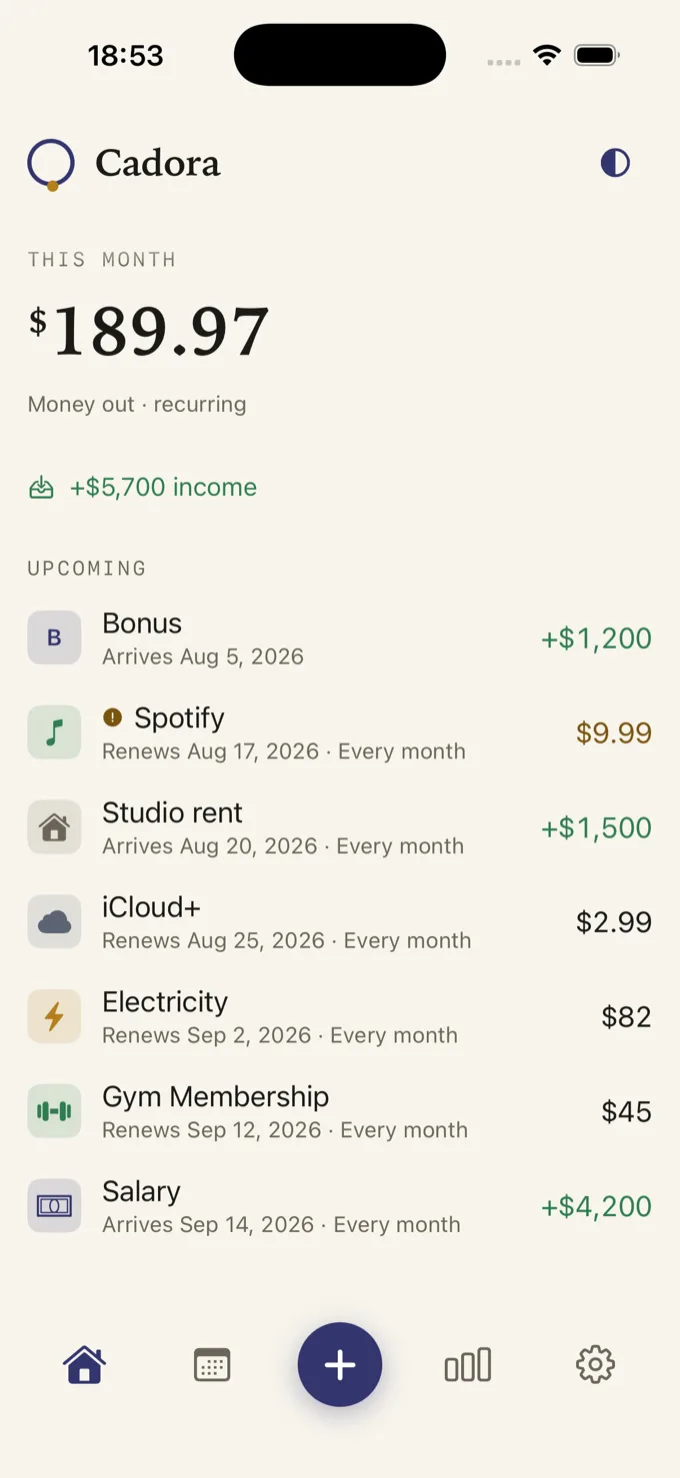
Cadora can schedule local reminders when enabled and add Cadora-created renewal events to Apple Calendar with permission. A reminder creates time to act; it cannot guarantee a provider will bill, cancel, or notify in a particular way.
3. Price rises become easy to absorb without review
Price notices are easy to swipe away. Write down the old price, the new price, and when it starts. A move from $9.99 to $12.99 is only $3 on a monthly receipt, but $36 over a year. Maybe it is still worth it. Maybe the lower tier is enough. The point is to answer that question once, instead of paying the new rate by default.
4. Cash-flow planning gets harder
Automatic payments are convenient when expected. CFPB guidance says to watch account balances and upcoming automatic payments because shortfalls can produce fees from a bank, credit union, or company. An untracked service does not automatically cause an overdraft; it is one more unknown in a tight month. List amount and date so the commitment is visible.
5. Duplicates and shared plans remain hidden
Two music services, duplicate cloud storage, a carrier benefit plus a direct plan, or a family plan plus a personal plan often look like separate charges until someone compares them. Record who pays, who uses it, billing path, plan owner, renewal date, and decision-maker before cancelling anything.
6. Cancellation follow-up becomes harder
Deleting an app does not necessarily end billing. Check actual billing path, cancel through official channel, save confirmation, note access-end date, then review a later statement. The FTC recommends retaining cancellation records and watching for later charges.
A 20-minute private reset
- Check Apple subscriptions, three months of statements, provider accounts, receipts, and payment-wallet automatic payments.
- Record provider, amount, cycle, next renewal, billing path, and status.
- Annualize prices: monthly × 12, quarterly × 4, yearly × 1.
- Mark keep, downgrade, pause, replace, cancel, or research.
- Set reminders before decision dates and schedule a monthly review.
Cadora suits this sort of housekeeping: add only what you want to track, keep the renewal dates beside it, and leave the bank account out of it. There is no Cadora account or email scan. Totals come from the numbers you enter.
Source note. Read current FTC subscription guidance and CFPB automatic-payment guidance for U.S. consumer information.