Short answer: before the year starts, list every subscription and give each one a verdict: keep, pause or cancel. Then add three rules: no new subscriptions or free trials, a price rise means a new decision, and every yearly renewal gets a review date. Subscriptions you keep aren’t a broken rule; ones you forgot are.
Why subscriptions need their own rules
A no-buy year is a promise to stop buying things you don’t need. Most people write rules for shopping: clothes, gadgets, takeaway. Subscriptions slip through because there’s no moment of buying. They renew quietly, and a price rise arrives as an email you don’t open.
Before 1 January: give every subscription a verdict
0 of 5 decided
Three rules for the year
- No new subscriptions, and no free trials. A free trial is a purchase with a delay. Most need a payment method and turn paid on their own.
- A price rise is a new decision. If a plan you kept gets more expensive, decide again as if you were starting it today.
- Every yearly renewal gets a review date. List the ones that fall inside the year now, with a reminder two weeks before each.
Some people add a fourth: one in, one out. If something new is essential, something of the same price goes.
A worked example
Demo values: eight subscriptions, not counting the phone plan.
| Subscription | Monthly | Verdict |
|---|---|---|
| Gym | $40.00 | Keep |
| Streaming A | $17.99 | Rotate |
| Meditation app | $12.99 | Cancel |
| Music | $11.99 | Keep |
| Streaming B | $9.99 | Rotate |
| Photo editor | $9.99 | Cancel |
| News app | $4.99 | Cancel |
| Cloud storage | $2.99 | Keep |
| Total | $110.93 |
Keeping three plans costs $54.98. Rotating the two streaming services, one at a time, adds at most $17.99, so the monthly total is at most $72.97. That is $37.96 a month less, or $455.52 over the year.
Shared plans and slips
Household plans need everyone’s agreement. A family streaming plan or shared cloud storage belongs to whoever pays, but cancelling it changes things for everyone. Decide those together before January, and write down who pays for what.
When something slips through, such as a yearly plan you meant to cancel, don’t write off the whole year. Turn off the next renewal, ask for a refund through whoever billed you, and add the date to your list. One forgotten renewal is a reason to fix the list, not to give up on the rules.
At the end of the year, look at what you paused. If you didn’t miss it in twelve months, that answers the question.
Keep one list all year
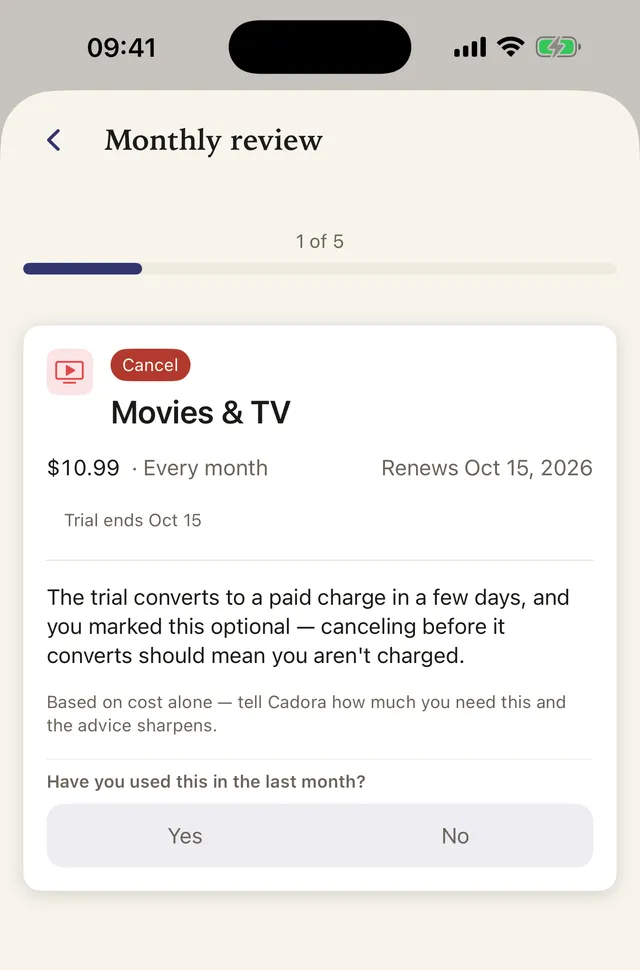
The plan only works if the list stays current: new prices, paused months, the yearly renewal in August. Cadora keeps that list on your iPhone or iPad. Add each subscription with its renewal date; Cadora totals them, reminds you before renewals when notifications are on, and its monthly review asks whether to keep, pause, downgrade or cancel each one. It doesn’t connect to your bank, so the list is what you decide to track.
FAQ
Do subscriptions count in a no-buy year?
You decide, but most rules treat existing subscriptions as decisions to make once, before the year starts. Keep what you use, pause what is seasonal, cancel the rest, and don’t add new ones.
Are free trials allowed in a no-buy year?
Most no-buy rules say no. A free trial usually needs a payment method and turns into a paid subscription unless you cancel in time.
What if a subscription I kept raises its price?
Treat it as a new purchase. Work out the yearly difference, then keep, downgrade, pause or cancel it before the new price starts.
Download Cadora on the App Store
Khai Do is an independent iOS developer in Vietnam who builds and supports Cadora under Aquifer.